Push Camera vs Video Borescope: Which Inspection Camera Type Do You Need? | JEET
A procurement team orders a $12,000 video borescope for inspecting 30-meter heat exchanger tube bundles — then discovers the articulation mechanism jams after the first 8 meters of straight push, and the probe is too stiff to navigate the U-bend at the end. Another team buys a $3,000 push camera for turbine blade inspection — then realizes it has no tip steering, so the inspector can only see what happens to drift in front of the fixed-forward lens. Both are real scenarios. Both stem from the same root cause: choosing the wrong inspection camera type for the application.
This guide cuts through the spec-sheet noise. We compare the four fundamental types of industrial borescopes and inspection cameras — rigid borescopes, fiberscopes, push cameras, and video borescopes — and give you a decision framework that maps your inspection geometry, access constraints, and documentation requirements to the right equipment type. No brand advocacy. No upsell. If you need a comprehensive borescope guide covering specs and selection, this article complements that resource by focusing on the one decision that determines everything else: which type do you actually need?
1. Why Choosing the Wrong Type Is Expensive
The industrial inspection camera market is not short on options — it is short on clarity. Manufacturers use overlapping terminology ("endoscope," "borescope," "videoscope," "inspection camera") for fundamentally different optical architectures, and procurement teams routinely over-specify (paying for articulation they will never use) or under-specify (buying a push camera when they need steerable tip navigation). The cost of a wrong choice goes beyond the purchase price.
3–5×
price gap between a push camera and a video borescope of equivalent probe diameter — yet many buyers pay the premium without needing articulation
0.5–8 mm
probe diameter overlap zone where fiberscope, push camera, and video borescope all compete — yet each serves a fundamentally different inspection geometry
60–80%
of industrial borescope warranty returns are attributable to application mismatch — not manufacturing defects — per industry service center estimates
The most common mistake is treating "borescope" as a single product category. A rigid borescope, a fiberscope, a push camera, and a video borescope are not variations of the same tool — they are four different optical technologies designed for four different inspection geometries. Choosing between them is not a matter of budget; it is a matter of physics.
The golden rule: Your inspection geometry — not your budget — determines the camera type. Start with the access opening diameter, the path geometry (straight vs. curved vs. branching), and the required working length. These three constraints eliminate 80% of the product catalog before you ever compare price or brand.
2. The 4 Types of Industrial Inspection Cameras
Before comparing specific types head-to-head, you need to understand what each one is — and just as importantly, what it is not. The four types below represent every optical architecture used in industrial remote visual inspection (RVI) today.
These four types are not evolutionary stages where "newer is better." A rigid borescope still produces superior image quality to a video borescope at equivalent cost. A fiberscope still accesses spaces no video sensor can physically enter. A push camera still reaches distances no articulated probe can push. The question is never "which is best?" — it is "which matches my inspection geometry?"
3. Push Camera vs Video Borescope: Head-to-Head
This is the comparison most procurement teams actually need. Both have a camera at the tip. Both display live video. Both capture images. But they are engineered for opposite inspection geometries — and confusing the two is the most expensive mistake in the RVI buying process.
| Dimension | Push Camera | Video Borescope |
|---|---|---|
| Tip articulation | None — fixed forward view (some models offer self-leveling) | 2-way, 4-way, or 360° electric articulation with joystick control |
| Probe diameter (typical) | 8–25 mm camera head — built for pipes, not precision machinery | 1.6–8.0 mm — fits spark plug holes, borescope ports, fuel injector nozzles |
| Working length | 20–60+ meters — the push rod stiffness enables long-distance advancement | 1–10 meters (15 m max with degraded articulation) — articulation cables add internal friction |
| Path geometry | Straight or gently curved pipes — cannot navigate sharp bends or branching paths | Complex cavities, curves, branches — steerable tip navigates around obstacles |
| Image resolution | 480p–720p typical — adequate for pipe wall corrosion, not fine crack detection | 1080p sufficient for hairline crack detection on turbine blades and welds |
| Lighting | Adjustable LEDs at camera head — bright enough for 50–200 mm pipe diameters | Adjustable LEDs at probe tip — optimized for 5–50 mm cavity illumination |
| Durability rating | IP68 standard — designed for submerged pipe environments | IP67 typical — splash and oil resistant; tungsten braid for abrasion resistance |
| Documentation | DVR recording with distance counter — adequate for pipe condition reports | Digital image/video with metadata, annotation, measurement — NDT-grade documentation |
| Price range | $1,500–$8,000 (industrial grade with DVR and locator) | $5,000–$30,000+ (articulating, HD, with measurement and reporting) |
| Typical applications | Sewer/drain lines, conduit, HVAC ducts, long pipe runs, petrochemical tubing | Turbine blades, engine cylinders, pressure vessels, welds, precision parts, castings |
The table makes the distinction look clean — but in practice, the two categories overlap in the 5–10 meter working length range, where both a long video borescope and a short push camera could theoretically reach the target. In that overlap zone, the deciding factor is simple: do you need to steer the tip? If the inspection target is visible by pushing straight to it, a push camera wins on cost and reach. If you need to look around a corner, up into a cavity, or systematically scan a surface at a specific angle, only a video borescope with articulation will work.
Hybrid systems exist — read the fine print. Some manufacturers market "articulating push cameras" that combine a push rod with a limited 2-way tip bend. These are genuine products, but the articulation range is typically 90° max (vs. 210°+ on a true video borescope), and the camera head diameter is still too large for precision machinery access. They are a compromise for pipe inspection with moderate bends — not a replacement for a video borescope in complex cavity work.
4. Fiberscope vs Video Borescope: When Fiber Optics Still Win
Video borescopes have largely replaced fiberscopes in general industrial inspection — but "largely" is not "entirely." Fiberscopes retain three niches where their optical architecture is not just competitive but irreplaceable. Understanding these niches prevents over-investing in a video borescope when a fiberscope would actually serve the application better.
Fiberscope Advantages
- Ultra-thin diameters: 0.5–1.0 mm — no video sensor package can match this. Critical for micro-orifices in fuel injectors, hydraulic valves, and medical device manufacturing.
- No electronics at the tip: The probe tip contains only glass fibers and a objective lens — no CMOS sensor, no LED, no solder joints. This makes fiberscopes inherently safer in explosive atmospheres (ATEX Zone 1, Class I Div 1) where spark risk must be eliminated.
- EMI immunity: Optical fiber transmission is immune to electromagnetic interference — important near MRI machines, high-voltage switchgear, and radar installations.
- Lower cost at small diameters: A 1.0 mm fiberscope costs less than half of a 1.0 mm video borescope, if the latter even exists.
Video Borescope Advantages
- Image quality: 1080p (2 MP) to 4K resolution vs. 10,000–30,000 fiber pixels. The difference is not subtle — it is the difference between seeing a crack and seeing the crack.
- Digital recording: Native image and video capture with metadata, annotation, and measurement — no external camera attachment needed.
- Superior articulation: Motor-driven 360° articulation with precise joystick control — fiberscope cable articulation is cruder and fatigues over time.
- Advanced features: AI defect detection, 3D measurement, dual-view cameras, WiFi streaming — all require digital sensor data that fiber optics cannot provide.
The decision rule is straightforward: if your access diameter is below 1.6 mm, or your environment is classified as explosive atmosphere and you cannot obtain an ATEX-certified video borescope, a fiberscope is the correct choice. In every other scenario — which is the vast majority of industrial NDT applications — a video borescope delivers superior image quality, documentation, and long-term value.
One practical note: many facilities maintain both. A fiberscope for the ultra-thin-access inspections that nothing else can reach, and a video borescope for everything else. If budget forces a choice, prioritize the video borescope — it covers 90%+ of typical inspection scenarios.
5. The 7-Question Decision Framework
Answer these seven questions in order. By question 4, you will have eliminated at least two of the four types. By question 7, you will have a clear specification shortlist — before you ever open a product catalog.
Q1. What is the minimum access opening diameter?
This is the hard filter. Measure the smallest bore, port, or orifice the probe must pass through. Below 1.6 mm → fiberscope only. 1.6–3.0 mm → video borescope (interchangeable probe). 3.0–8.0 mm → video borescope or push camera (depends on Q2–Q4). Above 8.0 mm → push camera or video borescope (depends on Q2–Q4).
Q2. Is the access path straight or does it require navigation?
Perfectly straight → rigid borescope (best image quality, lowest cost) or push camera (if long distance). Single gentle curve → push camera or non-articulating fiberscope. Multiple bends, branches, or complex cavity → video borescope with articulation. This question alone eliminates the rigid borescope for most industrial applications.
Q3. What working length do you need to reach the inspection target?
Under 1 meter → any type works. 1–10 meters → video borescope (articulation maintained) or push camera. 10–15 meters → video borescope with degraded articulation, or push camera. Above 15 meters → push camera is the only practical option — video borescope articulation cables cannot transmit control force over that distance.
Q4. Do you need to steer the camera tip to view specific surfaces?
If you need to look up, down, left, right, or at an angle while the probe is stationary → video borescope with 2-way, 4-way, or 360° articulation. If the target is visible by simply pushing straight to it → push camera. If you only need forward view in a straight line → rigid borescope. This is the question that separates push camera buyers from video borescope buyers.
Q5. What level of image detail do you need to detect the relevant defects?
General corrosion, blockages, gross deposits → 480p–720p (push camera or fiberscope). Fine cracks, weld undercut, surface finish verification, coating integrity → 1080p+ (video borescope). Microscopic defect analysis on aerospace components → 4K video borescope or rigid borescope with high-magnification objective. The defect type determines the minimum acceptable resolution.
Q6. What documentation and compliance requirements apply?
If you need NDT-grade inspection reports with annotated images, defect measurement, and traceable metadata (API 510/653, FAA AC 43.13, ASME Section V) → video borescope with digital reporting. If a video recording with distance counter suffices (pipe condition survey, pre-purchase inspection) → push camera with DVR. If no formal documentation is needed → any type, including rigid borescope with eyepiece.
Q7. Is the inspection environment classified as hazardous (explosive atmosphere)?
ATEX Zone 1 / Class I Div 1 → fiberscope (no electronics at tip) or ATEX-certified video borescope (significantly more expensive). ATEX Zone 2 / Class I Div 2 → standard video borescope with appropriate certification. Non-hazardous → any type. This is a binary filter that can override all previous answers — if you inspect inside a live petrochemical vessel, the hazardous area certification becomes the primary selection criterion.
6. Application-to-Type Matching Matrix
The framework above gives you the logic. The matrix below gives you the shortcut — mapped to real industrial applications across the sectors we cover in our scenario guides.
| Application | Access Dia. | Path | Length | Recommended Type |
|---|---|---|---|---|
| Aircraft engine turbine blades (HPT/HPC/LPT) | 4.0–8.0 mm | Complex cavity | 1–3 m | Video borescope (360° articulation) |
| Automotive engine cylinder bore | Spark plug hole (~6 mm) | Straight, short | 0.3–0.5 m | Rigid borescope or video borescope |
| Automotive cylinder head coolant passages | 3.8–6.0 mm | Curved, branching | 0.5–1.5 m | Video borescope (4-way articulation) |
| Heat exchanger tube bundle (straight tubes) | 12–25 mm | Long, straight | 3–6 m | Push camera (long reach, low cost) |
| Heat exchanger tube bundle (U-tube) | 12–25 mm | 180° U-bend | 3–6 m | Flexible video borescope (flexible probe) |
| Pressure vessel internal weld survey | Manway entry (100+ mm) | Open cavity, multi-angle | 1–5 m | Video borescope (360° articulation + measurement) |
| Underground drain / sewer line | 50–150 mm pipe | Long, gentle curves | 20–60 m | Push camera (self-leveling + sonde) |
| Fuel injector nozzle bore | 0.5–1.0 mm | Straight, very short | 10–50 mm | Fiberscope (ultra-thin) |
| Gun barrel / rifle bore | 5–20 mm | Perfectly straight | 0.5–1.2 m | Rigid borescope (highest resolution) |
| Storage tank floor & shell internal survey | Manway (600+ mm) | Open cavity, large surface | 2–10 m | Video borescope or pan-tilt-zoom camera |
Notice the pattern: applications requiring articulation (turbine blades, cylinder head passages, vessel welds) demand a video borescope. Applications requiring distance (drain lines, long tube bundles) favor a push camera. Applications requiring ultra-thin access (fuel injectors, micro-bores) require a fiberscope. Applications requiring maximum resolution in straight access (gun barrels, cylinder bores) are best served by a rigid borescope. The type follows the geometry — every time.
7. Probe Diameter & Key Specs Cheat Sheet
Once you have identified the correct camera type, the remaining specification decisions follow a predictable hierarchy. Probe diameter is always the primary filter — it determines what you can physically access. Everything else is optimization.
| Spec | Budget Tier | Professional Tier | NDT-Grade Tier |
|---|---|---|---|
| Probe diameter | 3.9–8.0 mm fixed | 2.2–6.0 mm interchangeable | 1.6–8.0 mm interchangeable |
| Resolution | 720p (0.3–1 MP) | 1080p (2 MP) | 1080p–4K (2–8 MP) + dual camera |
| Articulation | None or 2-way manual | 4-way joystick, 120°–180° | 360° electric, 210°+ per direction |
| Working length | 1–3 m | 1–5 m (custom to 10 m) | 1–10 m+ (articulation maintained to 10 m) |
| Probe material | PVC / rubber sheath | Stainless steel braid | Tungsten alloy braid, IP67, oil-resistant |
| Display | 3.5–5 inch LCD | 5–7 inch HD touchscreen | 7 inch FHD touchscreen, AR+AG glass |
| Measurement | None | Digital zoom, basic on-screen | 3D phase measurement, 5-point distance, stereo |
| Reporting | USB image/video export | Image annotation + report template | MDI auto-report, WiFi streaming, cloud sync |
| Typical price (USD) | $500–$2,000 | $3,000–$10,000 | $10,000–$30,000+ |
Don't over-buy articulation. If 80% of your inspections involve straight or gently curved access, and only 20% require tip steering, consider a push camera for the majority work and a mid-tier video borescope for the complex cases. Two purpose-built tools often cost less and last longer than one over-specified system pushed beyond its design intent.
8. Recommended Models by Inspection Type
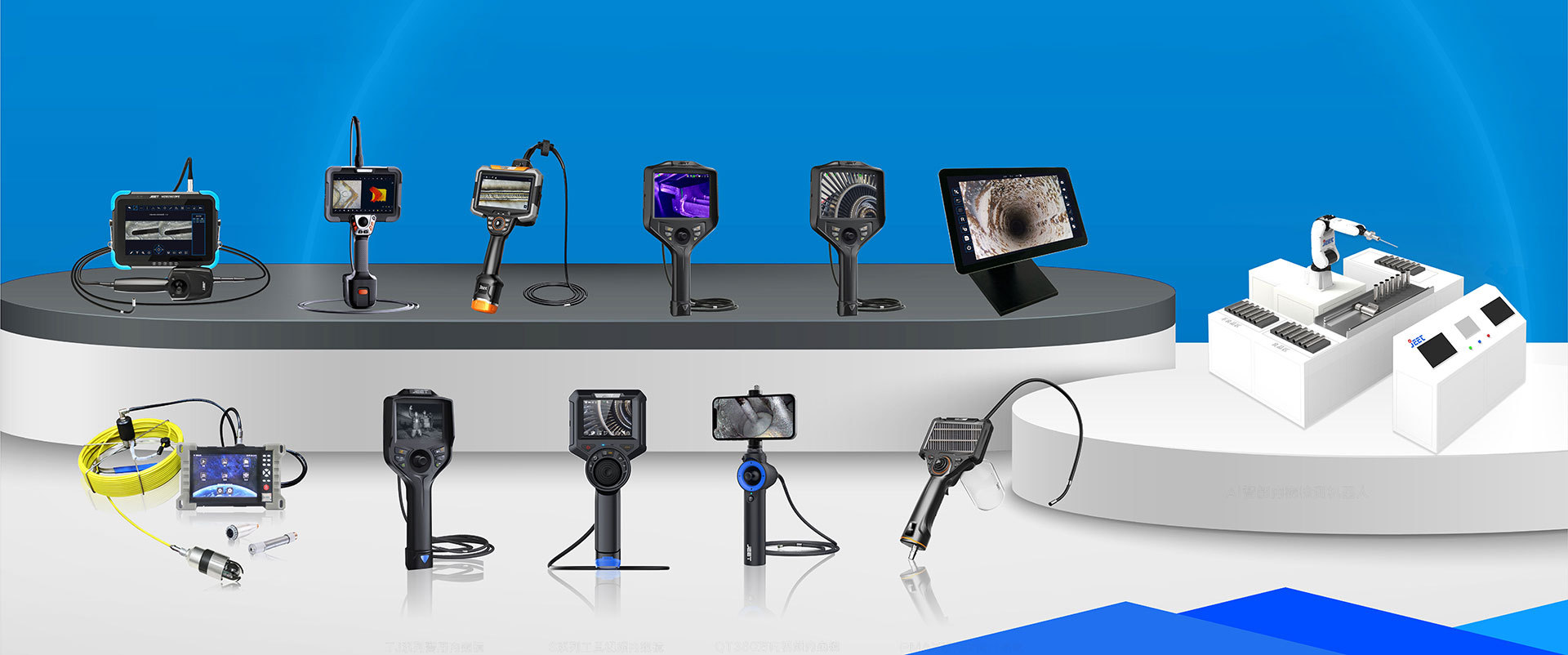
The [FILL: Brand] product line covers three of the four inspection camera types (rigid borescopes are a specialty category we do not manufacture). The recommendations below map common application profiles to specific model configurations — but every inspection geometry is unique. Use these as a starting point, then confirm probe diameter, working length, and articulation requirements with our applications team.
Not Sure Which Type Fits Your Inspection?
Send us your inspection target details — access diameter, path geometry, working length, and defect types you need to detect. Our applications engineers will recommend the correct camera type and probe configuration. No upsell, no brand pressure — just the right tool for the job.